
Green Walls vs. Acoustic Panels: Which Is Better for Office Acoustics?
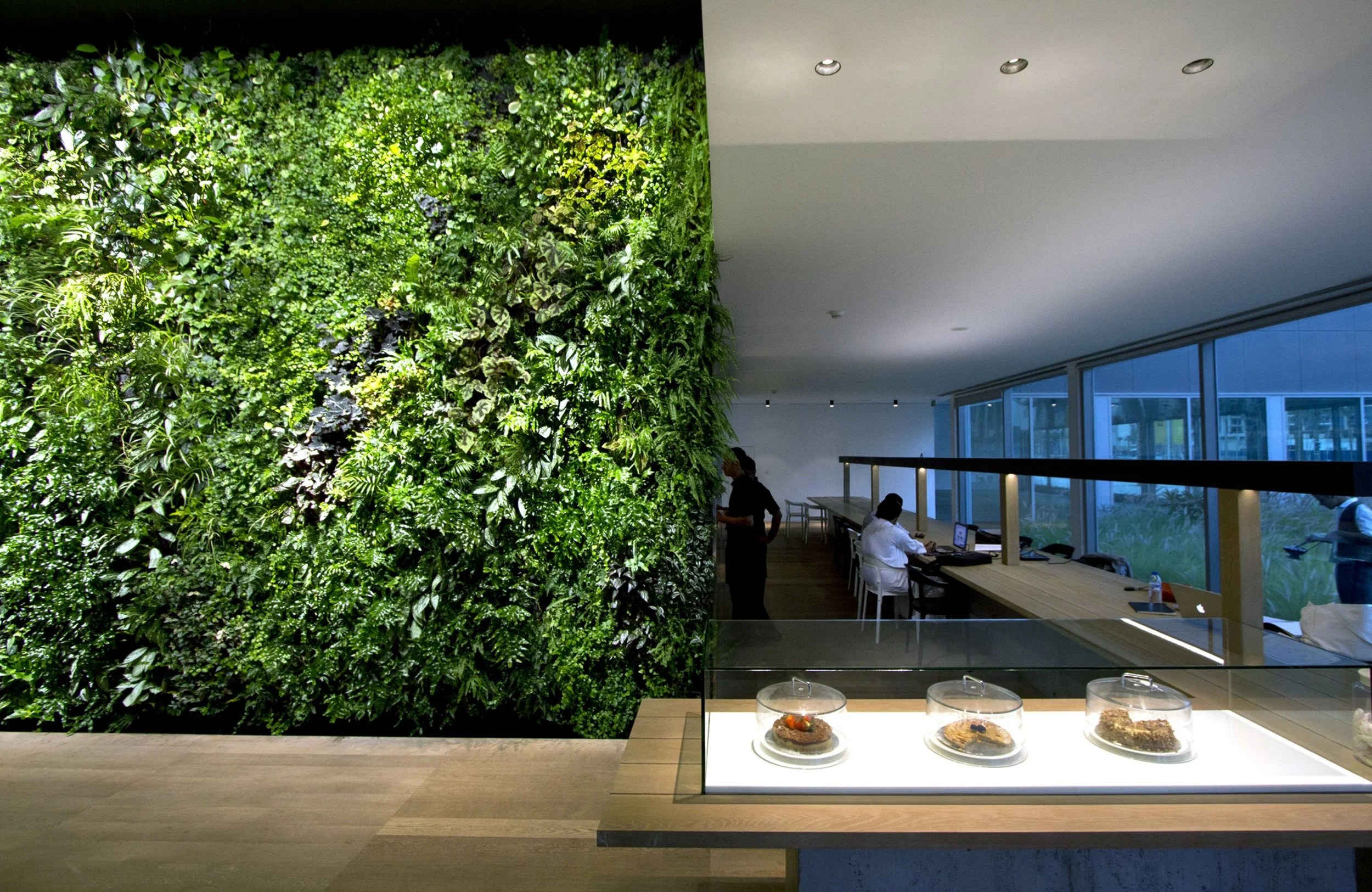
Living Wall- High End Restaurant
Walk into almost any new commercial interior and you'll find the same materials: glass partitions, polished concrete, exposed ceilings, open floor plans.
Architects love these finishes. They photograph beautifully. They signal a modern, transparent workplace.
Acousticians dread them for the same reason. Glass, concrete, and steel reflect nearly all the sound energy that hits them. Open layouts give that reflected sound nowhere to go but back into the room.
The result: a problem most companies don't notice until it's already costing them.
Conversations carry across the floor
Conference calls compete with kitchen noise
Employees put on headphones just to think
Restaurant dining rooms get so loud guests raise their voices at a two-top table
Why this matters, in numbers
20+ minutes/day — average time employees lose to conversational distractions in open-plan offices
#1 complaint — distracting speech and lack of speech privacy are the top-cited sources of dissatisfaction in large-scale office surveys
Poor acoustics also affects hotel lobbies, restaurant ambiance, healthcare confidentiality, and classroom comprehension
This is where green walls enter the conversation and not as decoration, but as a real acoustic strategy. Preserved moss walls and living plant walls are increasingly specified by architects who want a space that sounds better and looks like nothing else in the building.
Below: how they actually compare to traditional acoustic panels, and what the research really shows.
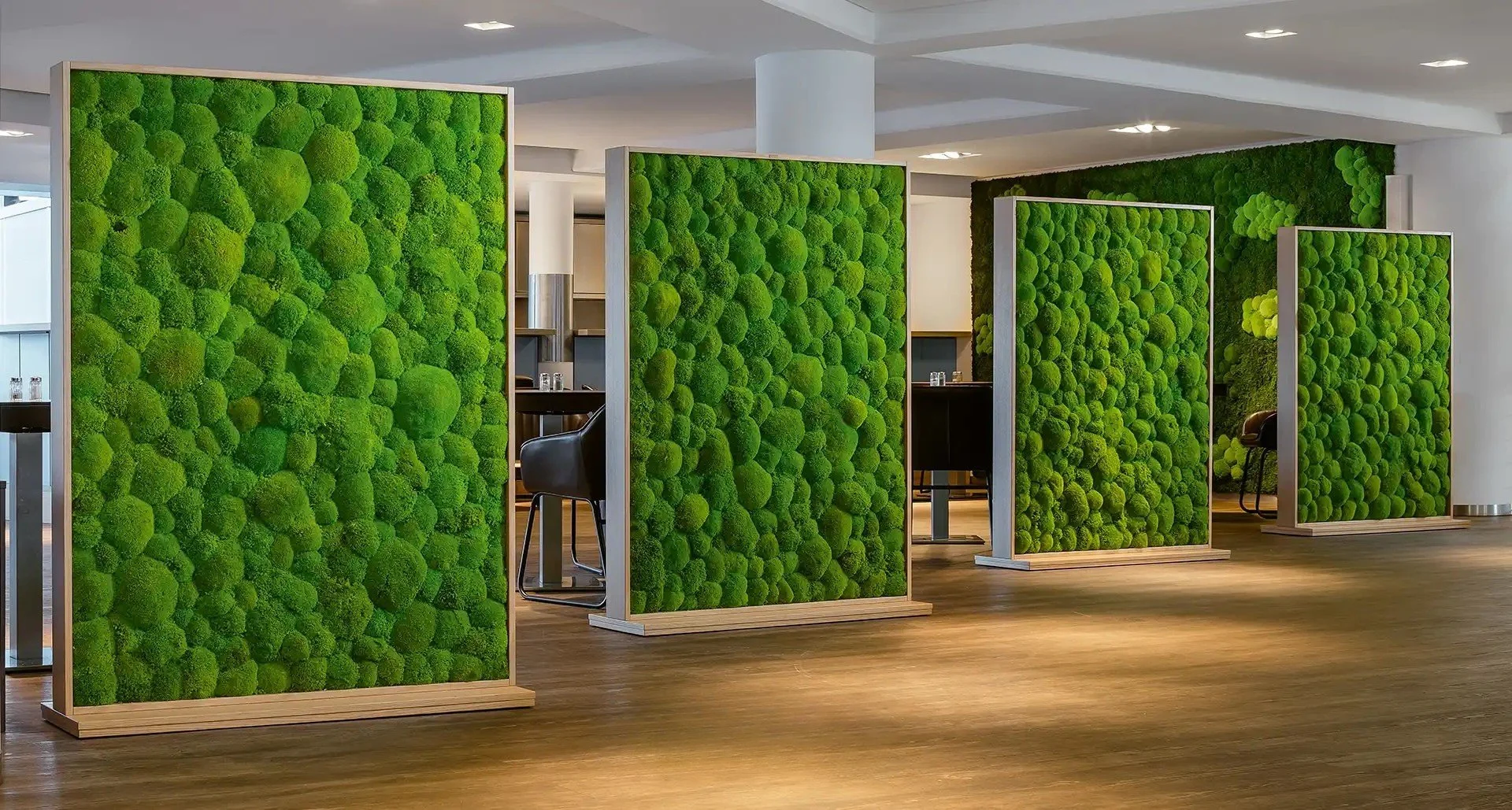
Moss dividers-Private Office Space
How Preserved Moss Walls Improve Acoustics
Preserved moss is real moss, harvested and treated with a glycerin-based process so it stays soft and vibrant indefinitely. No water, no sunlight, an no trimming.
Why it absorbs sound:
Irregular, porous surface — thousands of small, uneven clusters scatter sound instead of reflecting it cleanly
Soft material composition — moss fiber has none of the density of glass, drywall, or laminate
Layered installation — most commercial systems mount on a backing panel with an air gap behind it, adding a second layer of absorption
The research: A study by CARE CEDIA at the University of Liège, testing preserved moss to the ISO 11654:1997 standard, confirmed strong sound absorption performance. Commercial moss products now commonly publish Noise Reduction Coefficient (NRC) equivalent values of 0.6–0.9, depending on moss type and backing.
Best for:
Corporate offices & executive suites (doubles as a branded feature)
Conference rooms (improves speech clarity for hybrid meetings)
Reception areas & lobbies (first impressions + function)
Hospitality spaces wanting a photogenic, functional backdrop
How Living Plant Walls Improve Acoustics
Living walls take a different approach because they're built from several distinct layers; poly foam board or similar backing, multiple layers of felt, and the dense vegetation. Each contributing to sound absorption:
Foliage — diffuses sound at the surface, with more depth than moss depending on plant selection
Growing media (soil/substrate) — adds a porous absorptive layer behind the plants
Air cavity in the modular system — one of the most effective low-cost ways to boost low-frequency absorption
Leaf density & canopy depth — more surface area, more layers for sound to pass through and lose energy
The key peer-reviewed study
Researchers at the University of the Basque Country (Azkorra et al., Applied Acoustics, 2015) tested a modular green wall in a reverberation chamber under standardized lab conditions.
Results:
Weighted sound reduction index (Rw): 15 dB
Weighted sound absorption coefficient: 0.40
Performance was comparable to or better than common building materials
Notably strong at low frequencies , which is a range most thin acoustic materials struggle with
Why that matters: Most acoustic materials are optimized for mid-to-high-frequency speech absorption but do little for low-frequency HVAC rumble and foot traffic. A living wall's foliage + substrate + air cavity combination performs well exactly where it's usually hardest to get results.
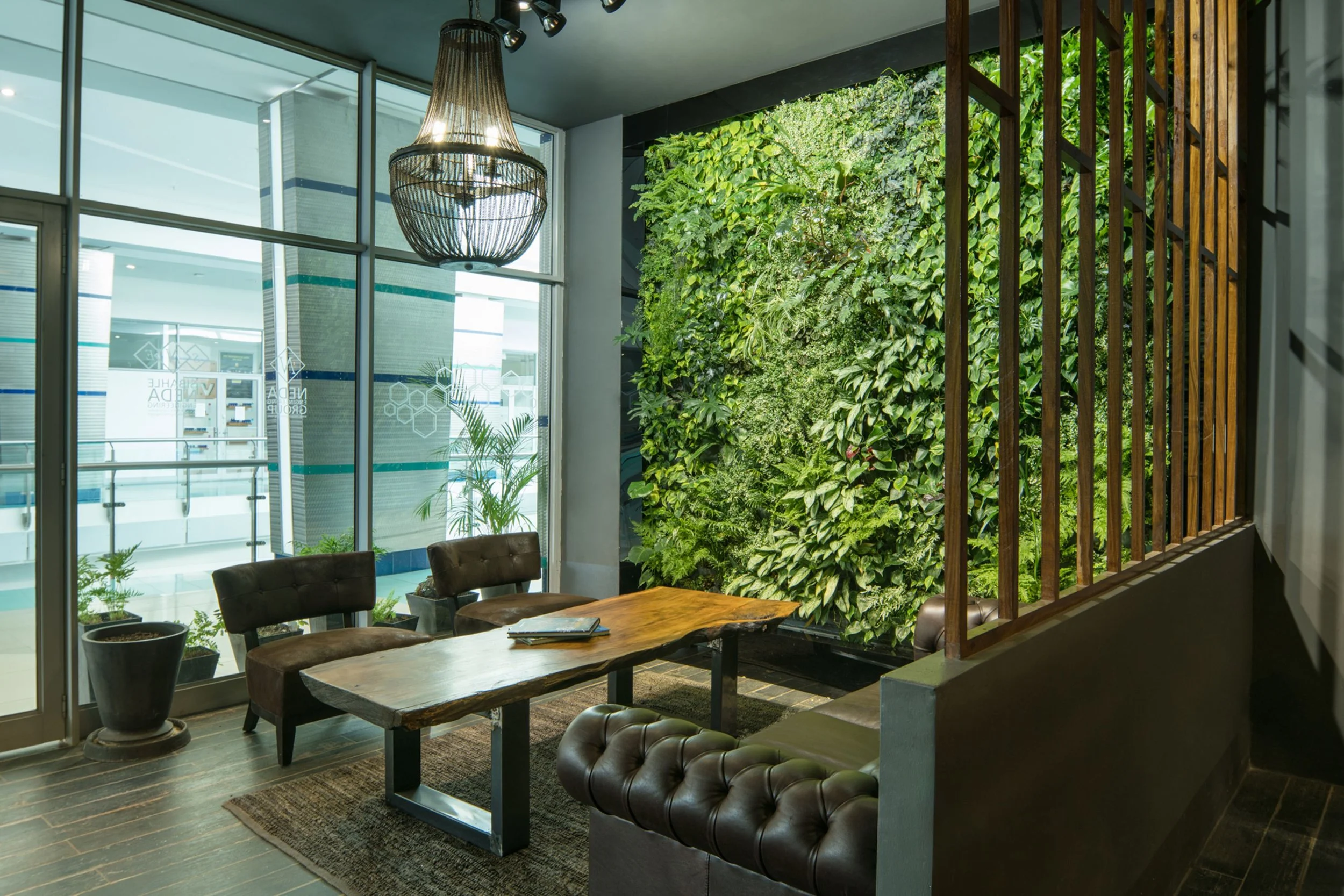
Living Wall-Private Office Lobby
Green Walls vs. Acoustic Panels: The Direct Comparison
Acoustic panels win on raw numbers. Fabric-wrapped panels are purpose-built for one job and that is for maximum sound absorption. They typically hit an NRC of 0.65–1.00. If the only goal is eliminating reflected sound in a call center or recording studio, panels are usually the right call.
Moss and living walls win on everything else. They deliver strong, measurable absorption (NRC 0.4–0.9 depending on product) while also functioning as the architectural centerpiece of the room which is something a fabric panel, hidden behind a finish meant to blend in, simply can't do.
That distinction matters more than it sounds. Acoustics is only one line on a project brief. Wellness, brand expression, sustainability story, and tenant experience now carry equal weight, especially for developers competing for tenants and companies competing for talent.
The wellness data acoustic panels can't touch
A global study of 7,600 office workers across 16 countries found that employees in workplaces with natural elements reported:
+15% higher well-being
+18% higher productivity
+15% higher creativity
No fabric acoustic panel delivers that. A moss or living wall does and on top of its acoustic contribution.
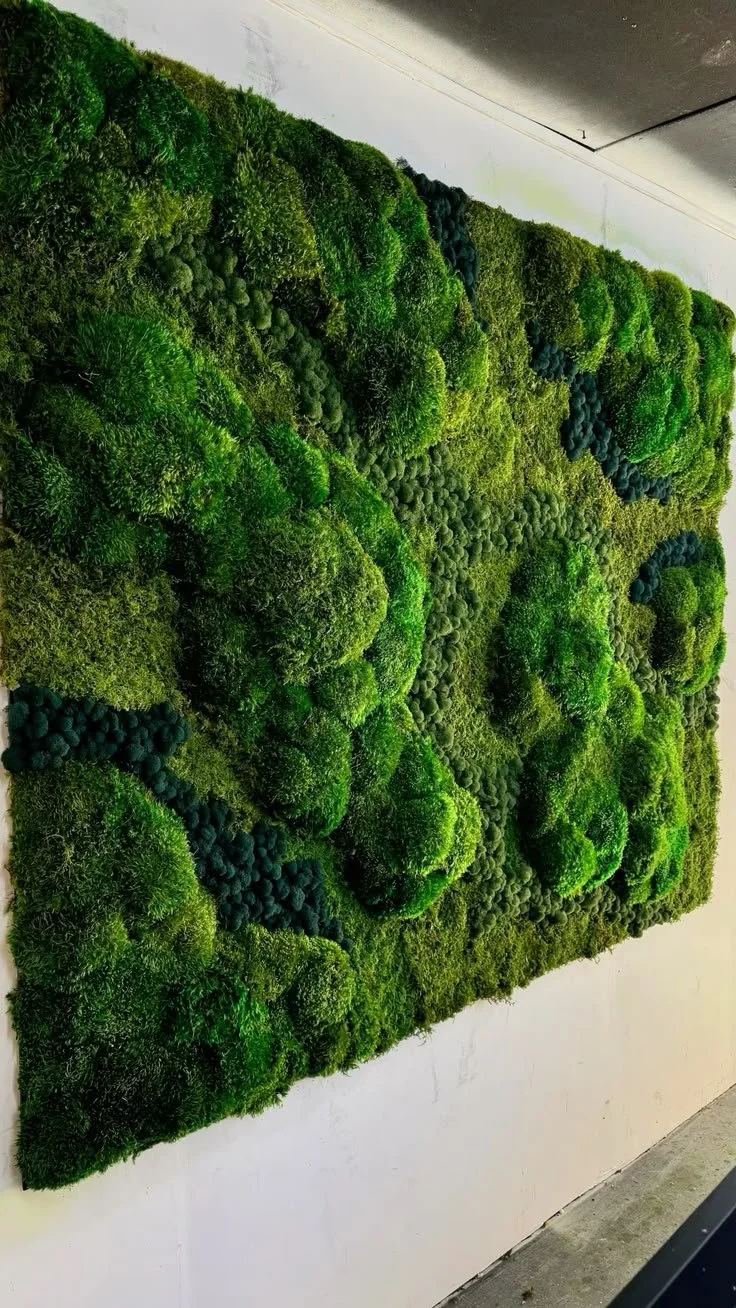
Preserved Moss Wall-Mixed Species
Final Thoughts
Acoustic panels can be the right call if sound absorption is the only objective. However, when is that the only objective in a publicly occupied space?
But most commercial interiors need to do more than control sound. They need to express a brand, support wellness, differentiate an experience, and photograph well.
That's the gap preserved moss walls and living plant walls fill — measurable, research-backed acoustic improvement, plus the architectural centerpiece a fabric panel was never designed to be.
At lily scott, we design, fabricate, and install custom preserved moss walls and living plant walls for architects, designers, developers, and clients nationwide from our studio in New York City.
Weighing acoustic strategy against design ambition for an upcoming project? Reach out to our team to talk through a custom-designed moss or living wall built around your space's goals.
External References
Azkorra, Z., et al. "Evaluation of green walls as a passive acoustic insulation system for buildings." Applied Acoustics, Vol. 89 (2015), pp. 46–56.
Human Spaces. "The Global Impact of Biophilic Design in the Workplace" (2015), led by Prof. Sir Cary Cooper.
ISO 11654:1997 — Acoustics: Sound absorbers for use in buildings, rating of sound absorption.
ASTM C423 — Standard Test Method for Sound Absorption and Sound Absorption Coefficients by the Reverberation Room Method.
Journal of the Acoustical Society of America — research on speech privacy and acoustic dissatisfaction in open-plan offices.
Lily Turner is a biophilic designer and living wall specialist with experience across the United States as a design-build practitioner. She works closely with architects, designers, and contractors to identify the right living wall approach for their budget, design parameters, and project scale. Lily brings a uniquely integrated perspective to living architecture; one that bridges design, planning, and development to recognize the social, environmental, and economic value of her systems. She can be reached at lily@lilyscottdesigns.com or www.lilyscottdesigns.com