
Preserved Moss Walls vs. Living Plant Walls: A Specification Guide for Architects & Interior Designers
When a client asks for a green wall, the first decision isn't about plant selection or aesthetic, it's about system type. Preserved moss walls and living plant walls are fundamentally different products with different requirements, project timelines, maintenance obligations, and costs. Specifying the wrong system for a project creates problems that are expensive to fix after installation.
This guide breaks down the key differences so you can make the right call at the schematic design phase; before MEP coordination, before contractor pricing, and before client expectations are set.
What Each System Actually Is
Preserved moss walls are moss panels of preserved moss species (not living moss) that has been harvested, treated with a glycerin-based preservation process, and stabilized. The result is a maintenance-free, inert product that retains its color and texture for 10–12 years under normal interior conditions. There are no living organisms, no irrigation, no soil, and no ongoing maintenance. It is a finish material, NOT a horticultural system.
Living plant walls is green wall technology in which live plants are cultivated in an inert, soil-free growing medium, typically a layered felt substrate, fed by an automated irrigation and nutrient delivery system. The plants are alive, growing, and require ongoing professional maintenance. The system has active mechanical components and must be integrated with the building's plumbing, electrical, and drainage infrastructure.
These are not interchangeable. The decision between them should happen in schematic design, not at the finish selection stage.
Side-by-Side Specification Comparison
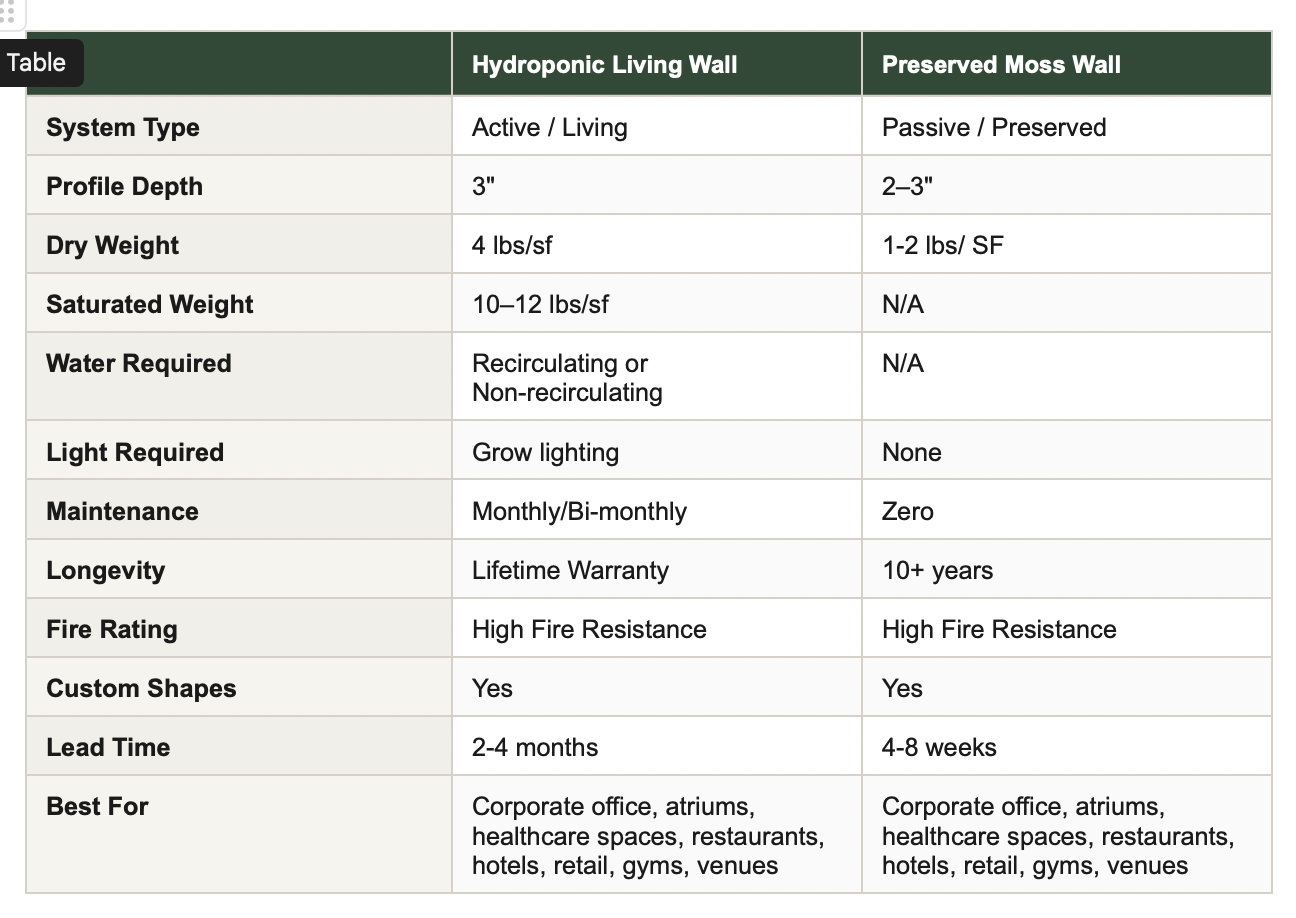
MEP Requirements
This is where the two systems differ most significantly from a coordination standpoint.
Moss wall panels require no MEP coordination. No plumbing, no drainage, no dedicated electrical. They are treated like any other wall finish.
Living walls require:
Plumbing: A dedicated water supply line and a drain or collection reservoir. The irrigation system must be designed with the project's MEP engineer. Drain placement relative to floor and wall assemblies must be resolved in design development (retrofitting a drain after the fact is disruptive and costly).
Electrical: Automated irrigation controllers, grow lighting (if natural light is insufficient), and system monitoring sensors all require dedicated circuits. Coordinate with the electrical engineer during CD development.
Lighting: Living plants require a minimum of 120–150 foot-candles of appropriate spectrum light to sustain health indoors. Supplemental grow lighting must be integrated into the RCP. This is not decorative accent lighting, spectrum and intensity matter.
Waterproofing: The wall assembly behind the living wall system requires a waterproof membrane. Irrigation leaks and condensation are real risks; this is a non-negotiable specification item.
Retrofit vs. New Construction
Preserved moss walls are retrofit-friendly. With no MEP requirements and light weight, they can be added to virtually any completed interior with minimal disruption. They are the go-to solution for tenant improvement projects, renovation scopes, and spaces where MEP changes are cost-prohibitive.
Living walls are best suited to new construction or major renovation where MEP infrastructure can be planned from the start. Retrofitting a living wall into a completed space requires opening walls for plumbing and electrical, structural review, and waterproofing, all of which add cost and construction duration. It is possible, but the economics shift significantly compared to new construction.
Environmental Conditions
Preserved moss walls perform best in stable interior environments with 30–60% relative humidity and indirect light. Direct sunlight will accelerate fading. They are sensitive to extreme dryness, in very low-humidity environments (below 30% RH), the moss can become brittle over time.
Living walls are more environmentally tolerant, provided their light and irrigation requirements are met. They actively regulate humidity, contribute to VOC reduction, and provide measurable acoustic benefits. Research supports improvements of up to 60% VOC removal per 100 sq ft, 20% reduction in employee fatigue, and 40% improvement in sound absorption. These are metrics preserved moss walls do not replicate.
How to Choose
Specify preserved moss when:
The project is a retrofit or tenant improvement with MEP constraints
Budget favors lower upfront cost and zero maintenance
Lead time is compressed
Structural load is a limiting factor
Specify a living wall when:
The project is new construction or major renovation with early MEP coordination
The client requires measurable environmental performance (wellness certifications, WELL, LEED)
Long-term ROI, productivity, and occupant health are part of the project narrative
The design calls for a large-scale, high-impact installation that needs to perform visually over decades
A Note on Early Involvement
For living wall systems in particular, the single most common and costly mistake is treating the green wall as a finish-phase decision. By the time CDs are issued, the opportunities to properly integrate plumbing, drainage, structural support, and lighting have often passed. Early involvement, at schematic design or design development at the latest, is what separates a well-executed system from a compromised one.
If you're currently in early design on a project where either system is being considered, the time to loop in your green wall consultant is now.
lily scott specializes in custom hydroponic living walls and preserved moss walls for commercial interiors across New York, Chicago, Miami, Philadelphia, Washington DC, and beyond. For specification support or to discuss an upcoming project, contact us at info@lilyscottdesigns.com or 929-925-4496.