Why Root Migration Is the Difference Between a Living Wall That Thrives and One That Barely Survives
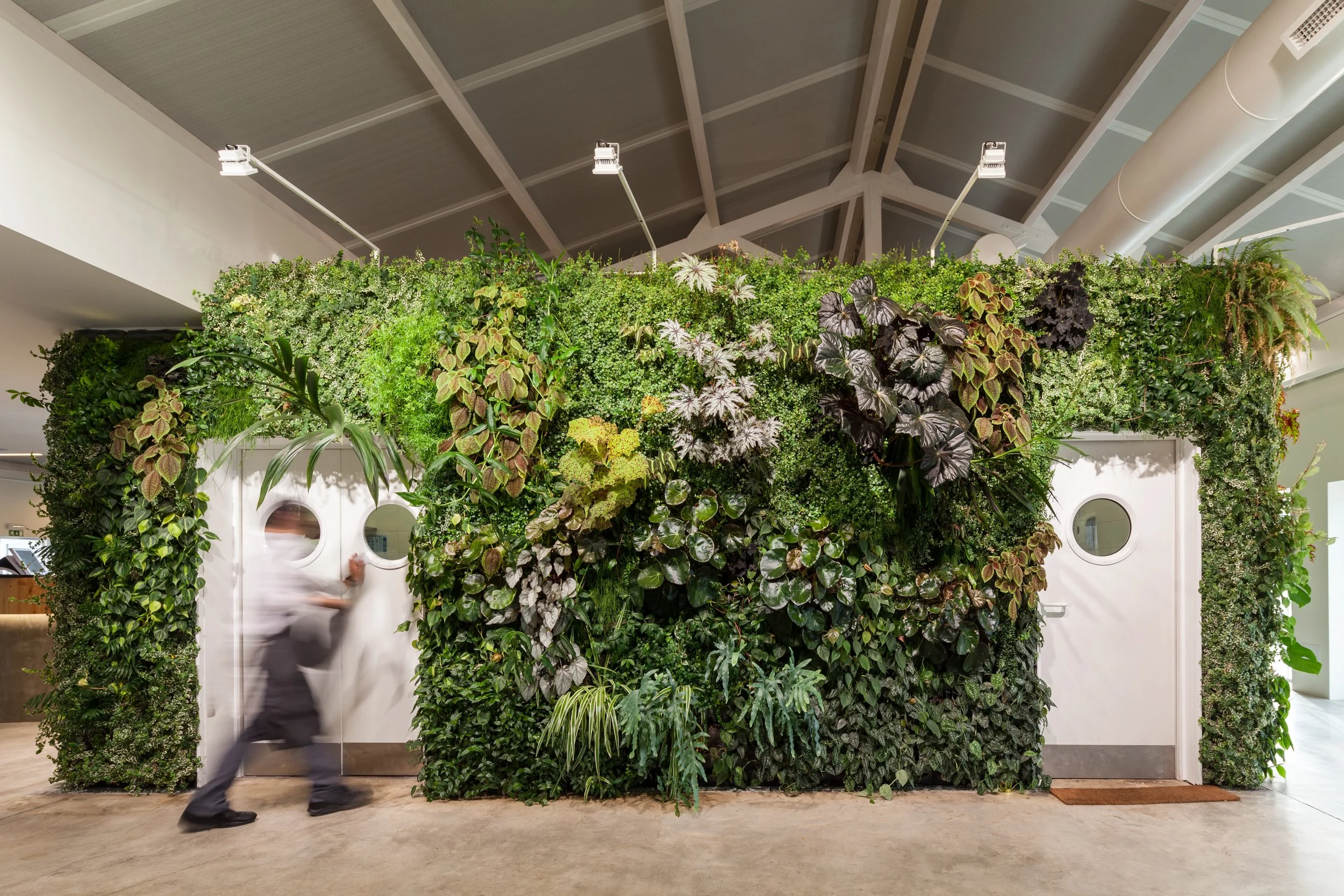
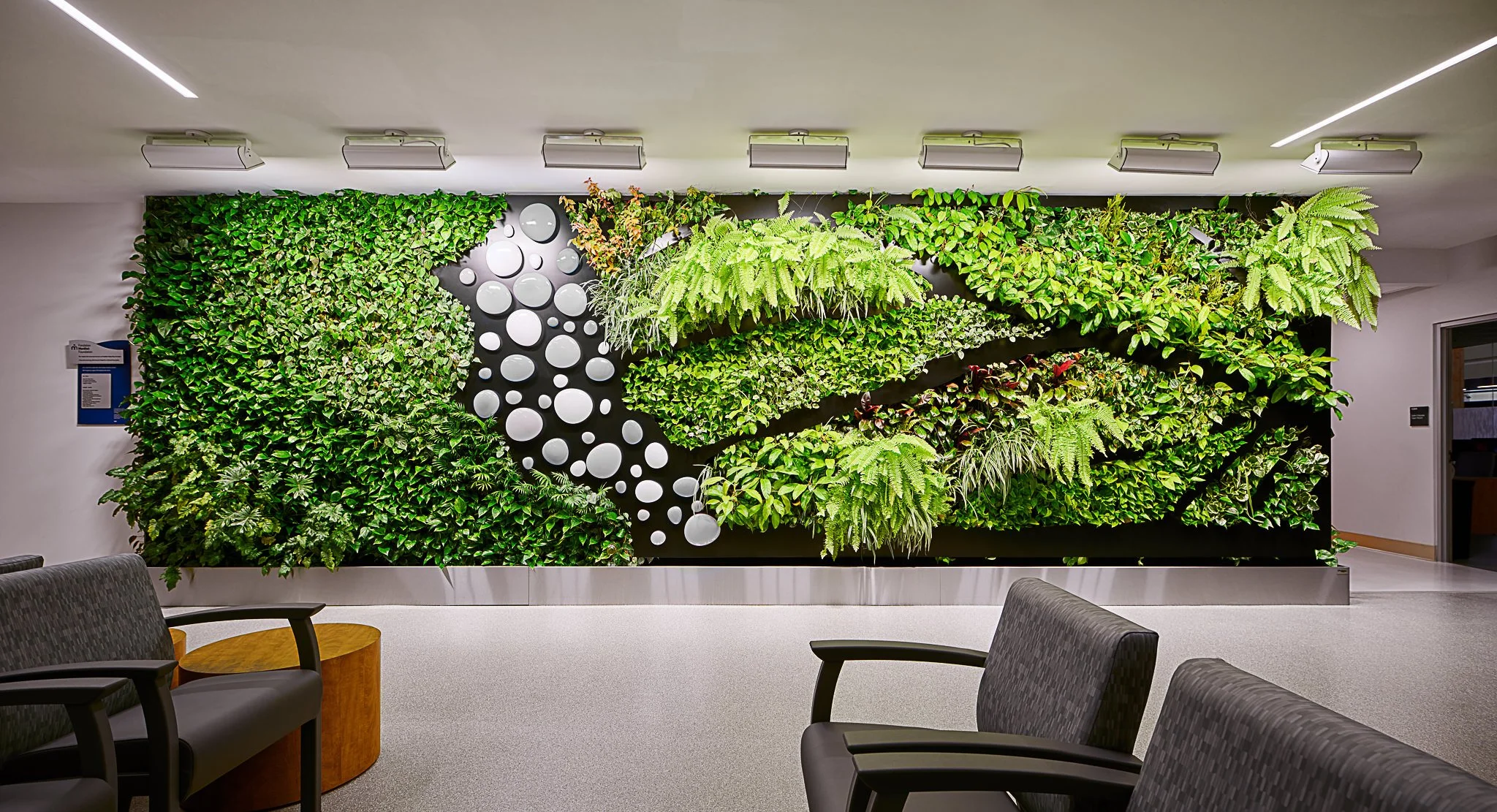
A thriving felt-based living wall system in the lobbyway of this health center.
There's a moment every living wall designer dreads: the call from a client, six months after installation, asking why half the plants look like they're dying. The wall looked lush the day it was installed but now there are brown patches, drooping leaves, and escalating maintenance costs that nobody budgeted for.
In most cases, if the plant selection, irrigation, and lighting is all adequate and optimal; the answer is almost always the same- the plants were never given the space to truly thrive.
The Hidden Problem with Tray-Based Systems
The dominant living wall system on the market today is, at its core, a sophisticated vertical arrangement of trays. Mass manufactured and 100% plastic. Each plant remains in their standard 4-inch nursery pot and slotted into a cubby. The tray is then mounted to the wall, sitting in a plastic trough that fills with water weekly.
This approach has real advantages. It's modular, it’s cheap and plants can be swapped out individually. For a portfolio photo taken shortly after installation, it looks pretty good. But the design contains a fundamental flaw: every plant is, from day one, a prisoner of its container.
A 4-inch pot holds roughly 12 cubic inches of growing medium. For a small annual herb or a delicate succulent, that might be sufficient indefinitely. But the tropical species typically specified for interior living walls; pothos, philodendrons, peace lilies, anthuriums, and ferns, it’s a huge issue. These plants evolved in rich, expansive rainforest environments where their root systems were free to explore soil in every direction. Asking them to perform in a 4-inch pot is like asking an athlete to train in a broom closet. They'll manage…..for a while but they'll never reach their potential, and the physical strain will soon show.
What Happens to a Plant That Becomes Root-Bound
When a plant's roots run out of room, the consequences follow.
The most visible sign is what we call “nesting, roots begin to circle the perimeter of the pot rather than growing outward. A plant that is literally choking itself cannot look healthy, no matter how carefully you water and fertilize it.
Nutrient uptake becomes inefficient. A dense, compacted root ball creates anaerobic zones, areas within the soil where oxygen cannot penetrate which promotes root rot. Compressed root systems also struggle to regulate their own hydraulic pressure, meaning the plant has difficulty drawing water upward even when moisture is abundantly available. The visible result: wilting, yellowing, and tip burn, even in a plant that's being watered on schedule.
A root-bound plant is a plant under chronic stress and that stress suppresses growth hormones. Once root-bound, the plant will produce fewer, smaller leaves. It will become increasingly vulnerable to pests and disease. And eventually, despite maintenance trips, it will need to be replaced.
For a tray-based system, this isn't an edge case. It's an inevitability built into the design.
The Case for Felt-Based Systems and Root Migration
Felt-based living wall systems work on an entirely different principle. Rather than isolating each plant in its own container, plants are established directly into felt-based media, typically multiple layers of a horticultural-grade fabric that acts also as a growing substrate, a moisture retention medium, and a root environment that closely mimics the aerated, fibrous conditions of natural forest soils.
The critical distinction is what happens after a plant is established: its roots are free to migrate.
Roots grow laterally and vertically through the felt media without restriction. A single pothos plant, given time, may develop a root system that spans several square feet of the wall surface, drawing moisture and nutrients from a vast zone of media, and contributing to the structural integrity of the felt matrix in a way that actually benefits neighboring plants.
The results are visible and measurable. Plants established in felt-based systems for several months develop root systems that are orders of magnitude larger and more complex than their tray-bound counterparts. They exhibit faster growth, greater canopies, and a higher resistance to pest infestation.
The Maintenance Equation
For clients, the financial argument is straightforward. A tray-based system with chronic root-bounding issues requires frequent plant replacement. After the first several months post installation, the extra maintenance costs of a tray-based system exceed the savings had, by opting for this cheap system rather than a highly-engineered felt-based system.
Designing for Plant Health First
The most important question to ask when evaluating a living wall system is not how low is the price or how easy it is to install. The most important question is: what happens to the roots?
If the answer is "they stay in a 4-inch pot," you already know what the long-term outcome will be. If the answer is "they migrate freely through the growing medium, establishing an expansive root system," you're looking at a reliable wall design.
Living walls are, by definition, alive. Designing them requires respecting the biological needs of the organisms at their core. Root migration isn't a feature, it should be a fundamental requirement for any system that aspires to deliver a truly breathtaking result.
Have questions about specifying the right living wall system for your project? Get in touch. info@lilyscottdesigns.com