
The Best Soil-Free Plants for a Living Wall or Vertical Garden
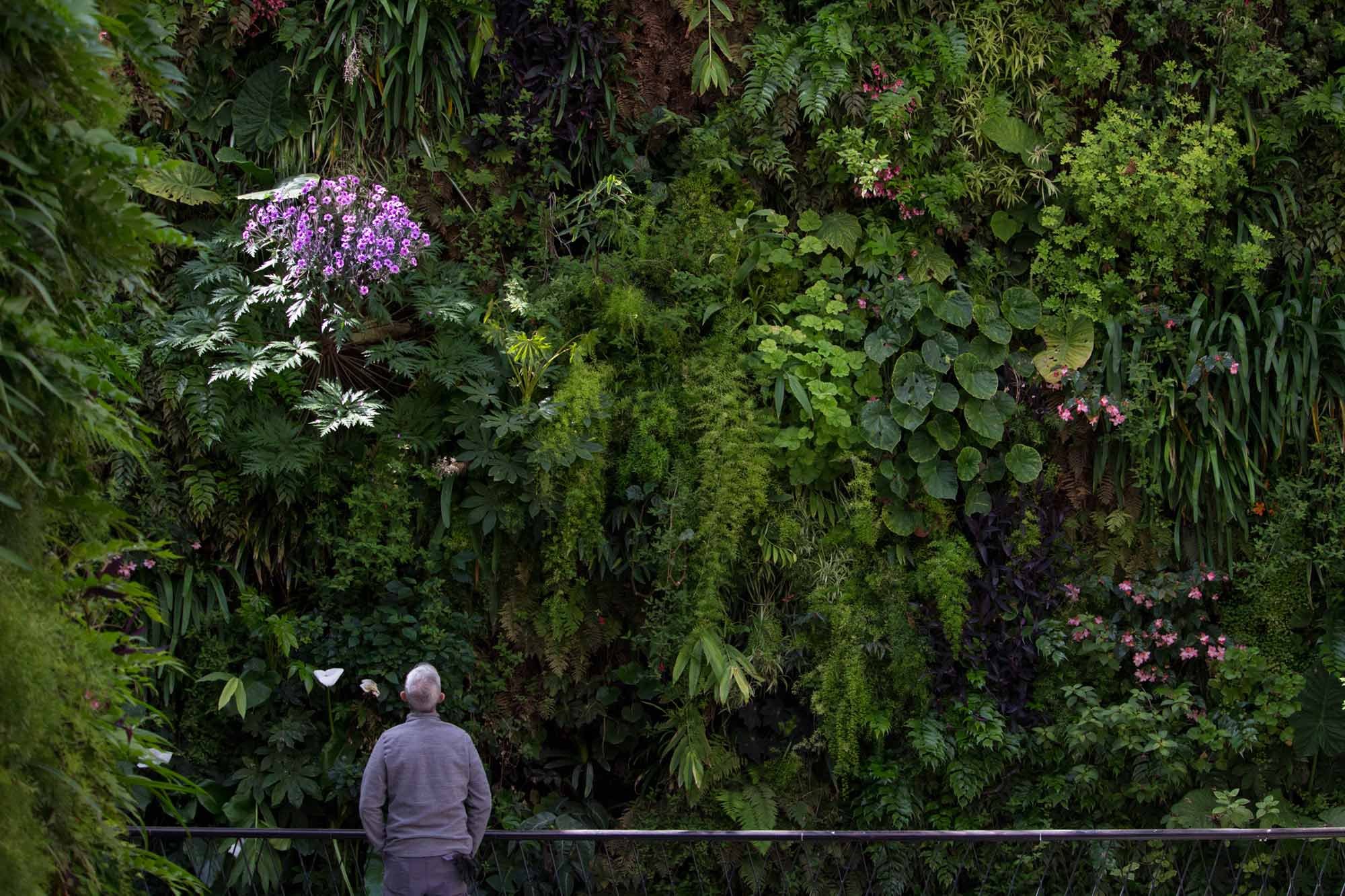
Exterior Living Plant Wall- Lisbon Hotel
Walk up to a lush, living green wall and your first thought is probably: how is any of this staying alive without a pot of dirt?
It's a fair question. Most of what we're taught about plants starts with soil. Roots go down, water and nutrients come up, and everything else is decoration. But a huge percentage of the plant kingdom never got that memo and they're thriving because of it.
Epiphytes, lithophytes, and hemiepiphytes are the plant world's ultimate minimalists. They've evolved to live on trees, cling to rocks, or start life dozens of feet in the air with zero access to traditional soil. And it turns out these soil-free survival strategies make them almost perfectly suited to modern indoor green wall and vertical garden design.
This is especially true with plant construction systems built around a felt substrate, like lily scott’s living wall system, where roots are encouraged to migrate laterally and vertically across a moisture-retentive surface instead of sitting in a static pot. Understanding why these plants don't need soil is the key to understanding why they're so good at this particular job.
Let's break down what these plants actually are, how they pull off their soil-free lifestyle, and which species make the best candidates for your next living wall project.
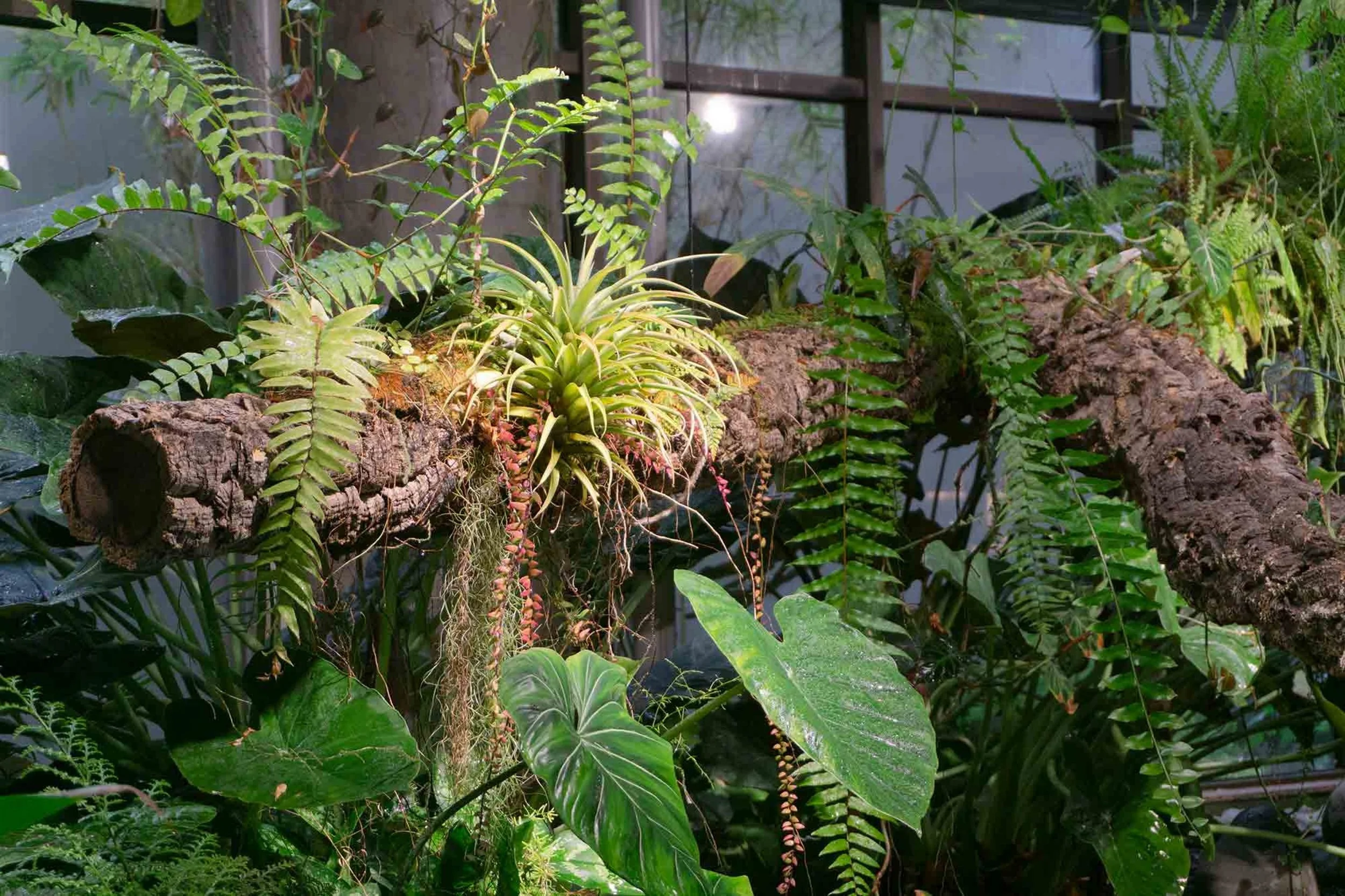
Bromeliad on a cork/bark log- Hotel Planter
What Is an Epiphyte, Exactly?
The word "epiphyte" comes from Greek: epi (upon) and phyton (plant). Literally, it means "a plant upon a plant."
Epiphytes grow on the surface of another plant, usually a tree, using it purely as physical support. They are not parasites. They don't tap into the host's vascular system or steal its nutrients.
Think of it like renting a apartment with a great view, rather than raiding your roommate's fridge.
In the wild, epiphytes are everywhere:
Perched on tree branches in tropical rainforest canopies
Wedged into bark crevices where organic debris collects
Clustered on trunks in humid, low-light understories
Growing on telephone poles, fence posts, and rock faces in the right climate
Roughly 10% of all known plant species are epiphytic, and the number climbs even higher in tropical rainforests, where epiphyte density can be staggering on a single mature tree.
Why Epiphytes Exist at All
Evolution rewards efficiency, and the rainforest floor is a rough place to compete. Sunlight is scarce down there, nutrients are locked up in competition with thousands of neighbors, and space is at a premium.
By growing up and out onto tree limbs, epiphytes solve several problems simultaneously:
Better light access — closer to canopy gaps and filtered sun
Escape from ground-level competition — no fighting other roots for space
Improved air circulation — reduces fungal and rot risk
Access to nutrient-rich debris — leaf litter, bark, and organic matter collect in the same nooks they occupy
It's a smart trade-off. They give up stable, soil-anchored nutrition in exchange for prime real estate.
What Is a Lithophyte?
Lithophytes take the same "grow without soil" philosophy and apply it to rocks instead of trees.
The name breaks down similarly: lithos means "stone." A lithophyte is a plant that grows directly on or in rock surfaces, cliff faces, boulders, or stony outcrops.
You'll find true lithophytes:
Clinging to canyon walls
Rooted into cracks and crevices in boulders
Growing on volcanic rock in exposed, high-light environments
Colonizing riverbed stones in seasonally wet zones
Many species that are technically epiphytic are also facultative lithophytes — meaning they're flexible. Give them a rock instead of a tree branch, and they'll adapt just fine. This dual-mode flexibility is a big reason so many of these plants transition well into constructed environments like a plant wall or green wall system, where the "host surface" is neither a tree nor a stone, but an engineered felt substrate.
What Is a Hemiepiphyte?
Hemiepiphytes are the shape-shifters of the group, and honestly, the most fascinating.
The prefix hemi means "half," and that's exactly what's going on: these plants live part of their life cycle as a true epiphyte and part of it rooted in soil. There are two main strategies.
Primary hemiepiphytes start life high in the canopy — often germinating from a seed dropped by a bird or bat onto a tree branch. They grow as epiphytes for a while, then send roots downward, eventually reaching the soil below and rooting in.
Secondary hemiepiphytes do the reverse. They start life rooted in the ground like an ordinary plant, then climb a tree trunk, and eventually lose or reduce their connection to the soil, functioning as a true epiphyte for the rest of their life.
The most famous example most people already own is Monstera deliciosa. In the wild, it germinates on the forest floor, then climbs trees using aerial roots, eventually functioning largely as an epiphyte high above the ground — even though it started rooted in soil.
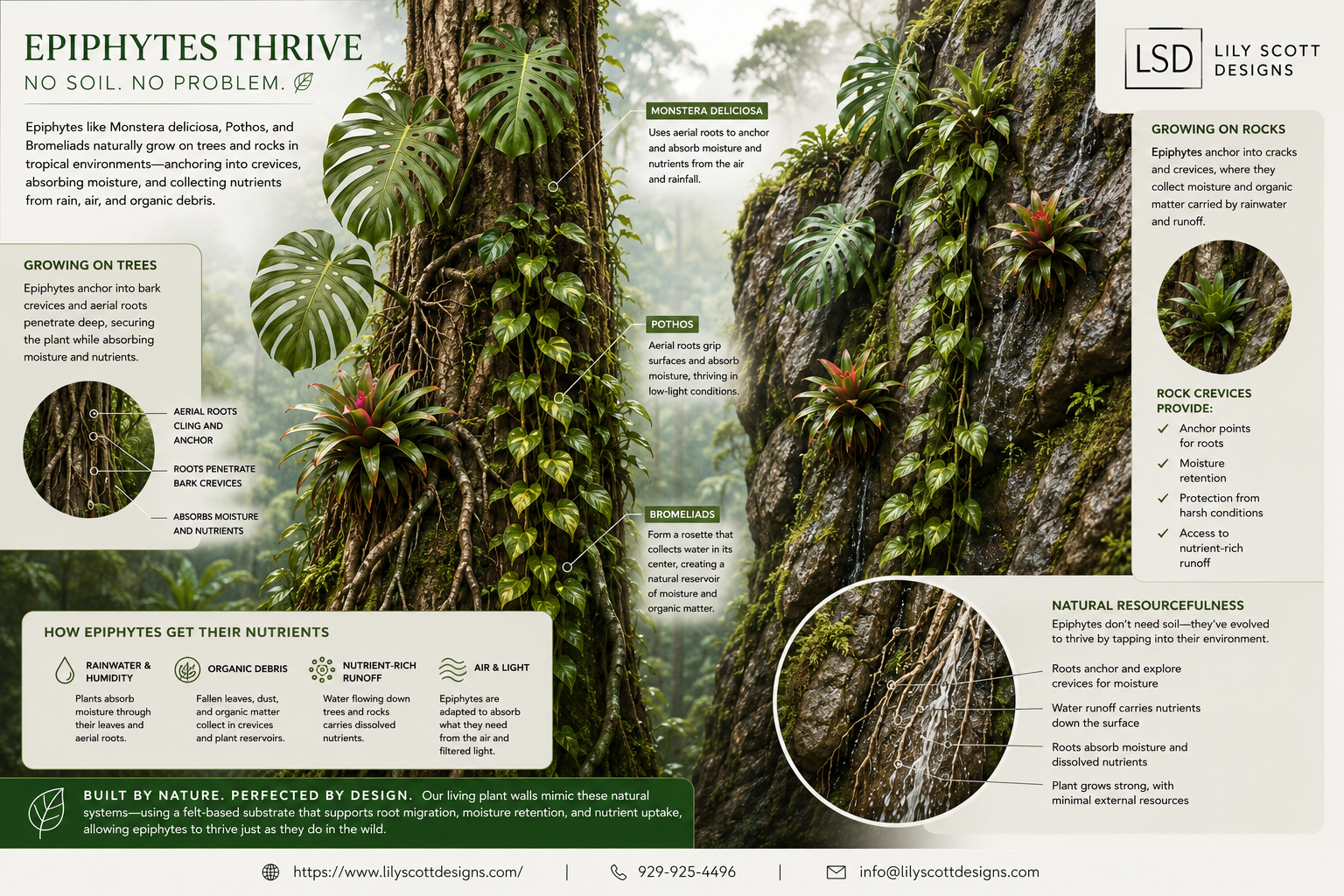
Infographic by lily scott
How Do Plants Survive Without Soil?
This is where things get genuinely clever. Soil does three main jobs for a plant: it anchors the roots, it holds water, and it supplies nutrients. Epiphytes, lithophytes, and hemiepiphytes had to solve all three problems separately — and they did.
1. Anchoring Without Digging In
Instead of roots that burrow downward, these plants evolved roots built for gripping.
Aerial roots wrap around bark, wood, rock texture, or felt fibers
Some produce flattened, disc-like root pads that press flush against a surface
Root hairs and fine root tips wedge into microscopic crevices for a mechanical hold
This is precisely the mechanism that makes lateral and vertical root migration possible in a felt-based living wall. The roots aren't looking for loose dirt to push through — they're looking for a fibrous surface to grip, spread across, and travel along in any direction, exactly like felt.
2. Capturing Water From the Air, Not the Ground
Without soil to hold a water reserve, these plants had to get inventive about hydration.
Velamen — a specialized, spongy outer root layer found in orchids and many aroids — absorbs moisture directly from humid air and rainfall, then holds it against the root
Tank rosettes, seen in many bromeliads, form a central cup of overlapping leaves that physically collects and stores rainwater
Succulent leaves and stems store water internally for use during dry stretches
CAM photosynthesis (Crassulacean Acid Metabolism) lets many epiphytes open their leaf pores at night instead of during the heat of day, dramatically cutting water loss
This is also why moisture-retentive felt performs so well as a growing medium. It mimics the humid, absorbent bark and rock surfaces these plants evolved to live on, releasing moisture slowly instead of flooding and draining like potting soil.
3. Finding Nutrients Without Roots in the Ground
Nutrients are the trickiest problem, and epiphytes solve it through resourcefulness rather than brute force.
Decomposing leaf litter and debris collect naturally around root masses and get broken down in place
Bird and bat droppings deposit nitrogen and other nutrients directly onto leaves and roots
Mycorrhizal fungi form partnerships with roots, extending their effective reach and trading sugars for minerals
Some species even trap falling debris deliberately, forming a self-made compost pocket within their own root structure
In a constructed living green wall, this natural nutrient-scavenging strategy translates beautifully into an irrigation-and-fertigation system. Instead of waiting for bird droppings and leaf litter, the wall delivers a steady, diluted nutrient stream directly to a root system that's already evolved to absorb nutrients efficiently from a flowing, non-soil source.
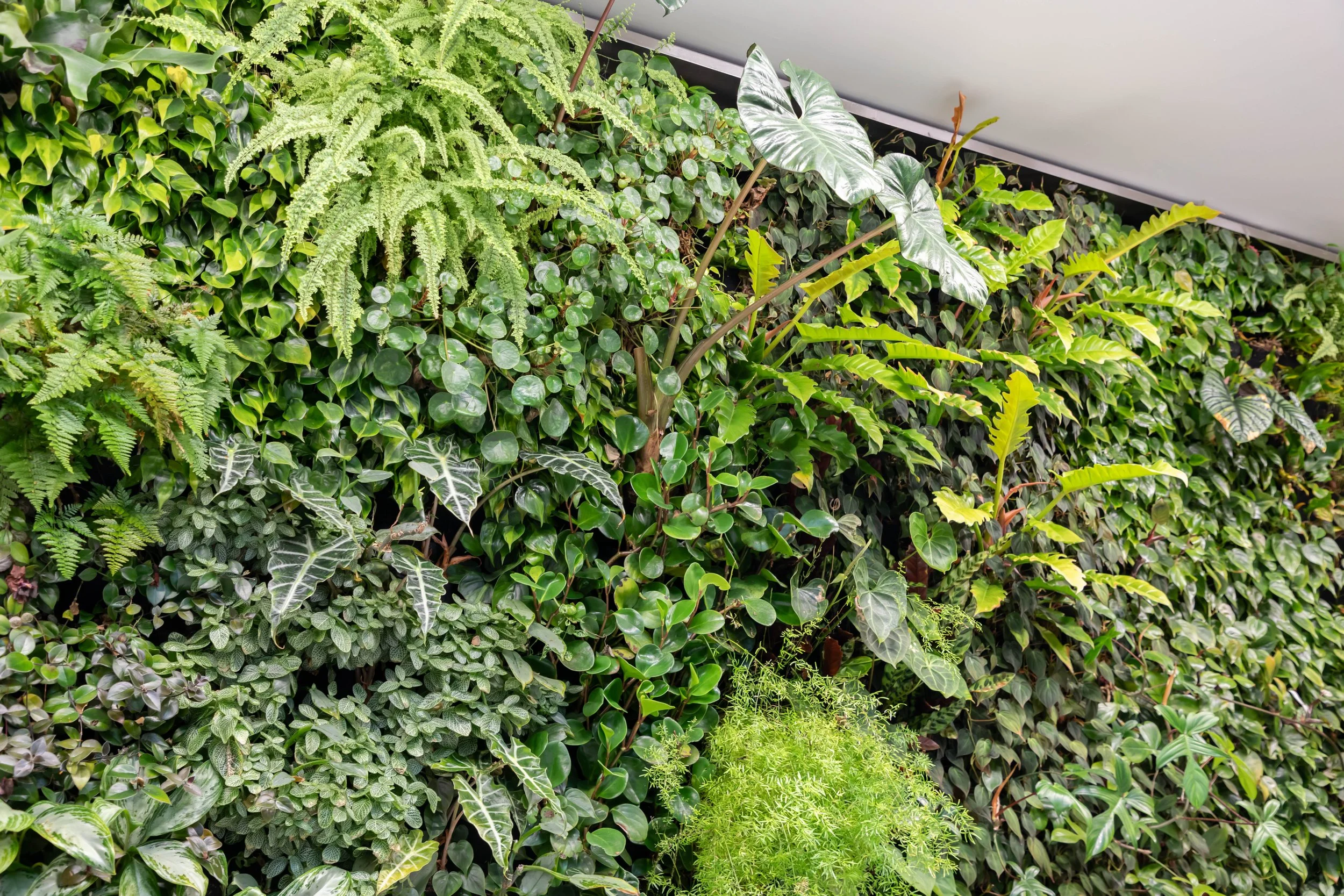
Close-up Living Wall Featuring Anthuriums, Philodendrons, and Ferns
Why These Plants Are Perfect for Felt-Based Living Wall Systems
Once you understand the survival mechanics, it makes total sense why epiphytes, lithophytes, and hemiepiphytes dominate high-performing indoor plant wall installations.
A felt-based system like Lily Scott's living wall approach is essentially engineering an artificial version of the exact environment these plants evolved for:
Fibrous surface for gripping — felt fibers replicate bark texture and rock crevices, giving roots something to physically hold onto
Moisture retention without saturation — felt absorbs and slowly releases water the way humid bark or a bromeliad tank does
Open lateral and vertical space — roots aren't boxed into a pot; they can travel sideways and downward exactly as they would across a tree trunk or cliff face
Air exposure at the root zone — unlike compacted soil, felt allows airflow around roots, mimicking the well-ventilated conditions these plants need to avoid rot
Distributed nutrient delivery — irrigation systems feed nutrients directly to root surfaces, replacing the debris-and-droppings method nature relies on
Feeding Like the Forest: Proportioned Fertigation
In the wild, these plants never get a single heavy dose of nutrition. They get small, steady amounts delivered constantly; a trickle of nutrient-laden runoff washing down bark after a rainstorm, a light dusting of dissolved droppings, a slow release from decomposing debris nearby.
A well-designed living wall system replicates that same rhythm instead of fighting it. Rather than dumping a concentrated feed all at once, fertilizer is proportioned in small, diluted amounts and injected directly into the programmed watering cycles, so every irrigation pass carries a light, consistent nutrient load to the root zone.
This mimicry matters for a few reasons:
Prevents nutrient burn — epiphytic and hemiepiphytic roots are adapted to dilute, frequent feeding, not concentrated soil-based fertilizer, so a lower, steadier dose keeps root tips and velamen from being damaged
Matches natural uptake patterns — these species evolved to absorb nutrients efficiently in small increments rather than storing large soil-based reserves, so frequent micro-feeding is actually more effective than infrequent heavy feeding
Reduces salt buildup on felt — proportioned dosing paired with regular watering cycles helps flush the felt surface, preventing the mineral crust that can form when fertilizer is over-applied
Keeps growth steady rather than spiky — a consistent low-level nutrient supply produces more even, sustained growth than the boom-and-bust cycle of occasional heavy feeding
In practice, this means the irrigation controller and the fertilizer injector need to work as one system, timed and proportioned together, not treated as separate tasks. Done well, it's the closest thing an indoor wall can offer to the slow, natural drip-feeding these plants would receive clinging to a rainforest canopy or a mineral-rich rock face.
This is really the heart of good greenery design for interior spaces: choosing species whose natural biology already matches the mechanics of the system, instead of forcing soil-dependent plants into an environment they're fighting against the whole time.
It's also why artistic greenery installations built from epiphytic and hemiepiphytic species tend to look so much fuller and more organic over time. Roots migrating freely across a felt surface create a dense, interwoven root mat that mirrors how these plants naturally colonize a tree trunk or rock face in the wild — which is part of what makes a mature green wall system look like a slice of rainforest instead of a row of potted plants stuck to a panel.
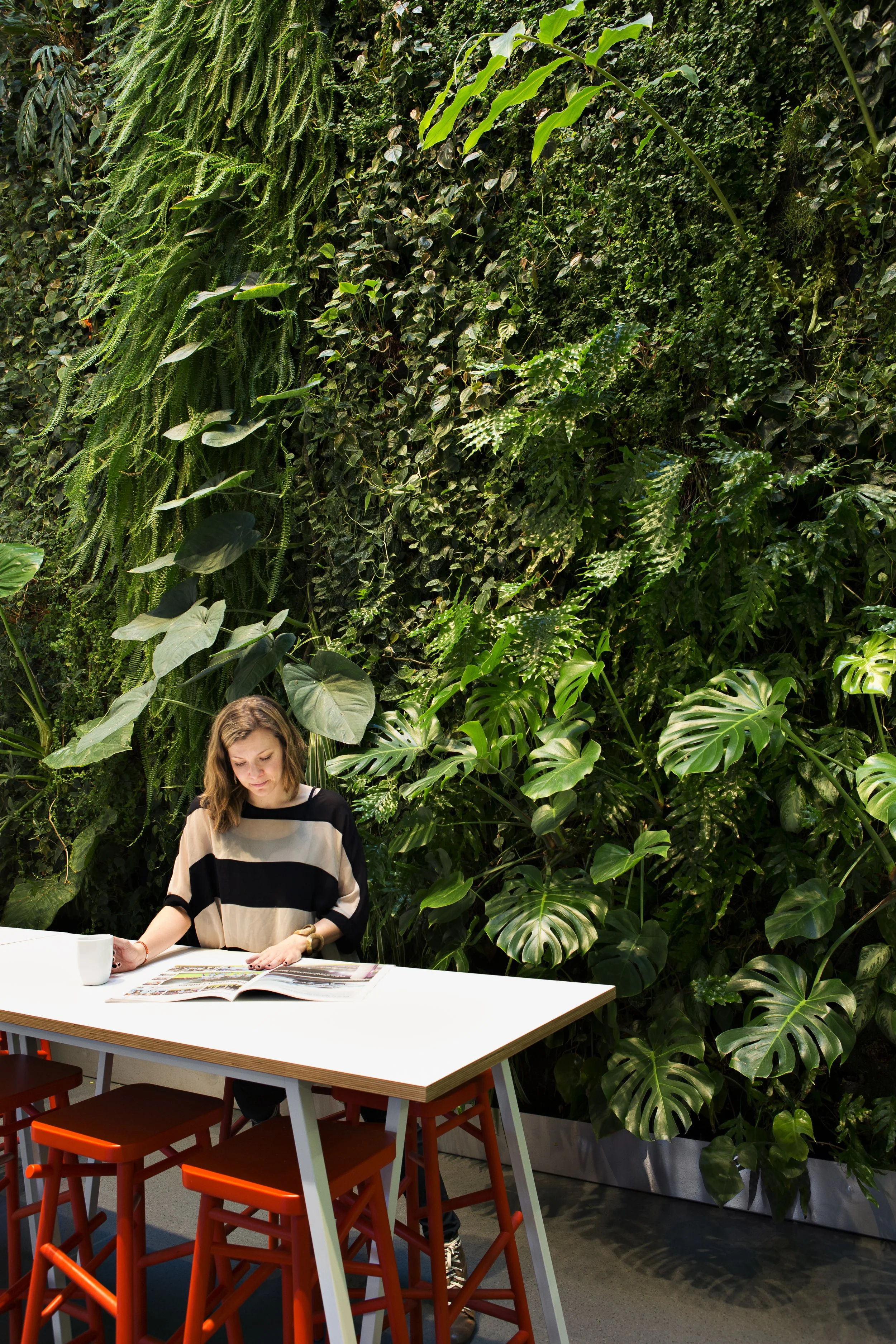
Office Plant Wall- Epiphytes
Popular Epiphyte/Hemiepiphyte Species for Living Walls
Not every soil-free plant is a good fit for a vertical garden, but the species below are proven, popular performers in felt-based living green wall systems. Here's a quick guide to each.
Monstera Deliciosa
The signature hemiepiphyte, famous for its split leaves and aerial roots. It transitions naturally between soil-rooted and epiphytic growth, making it exceptionally forgiving in a felt system.Orchids
Many orchid genera are classic epiphytes with thick velamen-covered roots built for gripping and rapid water absorption. Their aerial-root biology is practically a textbook match for felt substrates.
Anthurium spp.
A large genus of aroids, many of which grow epiphytically in humid, warm conditions. They bring bold foliage and, in flowering varieties, long-lasting blooms to a wall composition.
Anthurium veitchii
Known as the "King Anthurium," this species produces dramatic, deeply quilted leaves that can grow several feet long. It's a showstopper for a plant wall with enough vertical clearance.
Elephant Ear
Several elephant ear species tolerate epiphytic or near-epiphytic growth and bring huge, dramatic leaf shapes to a wall for scale and texture contrast.
Bromeliads
The tank-forming rosette structure of bromeliads is one of nature's best water-storage adaptations. They're low-maintenance, visually striking, and extremely well-suited to non-soil systems.
Hoyas
Vining, semi-succulent epiphytes with thick, waxy leaves built for water retention. Hoyas trail beautifully and add movement to a vertical composition.
Monstera Deliciosa
The signature hemiepiphyte, famous for its split leaves and aerial roots. It transitions naturally between soil-rooted and epiphytic growth, making it exceptionally forgiving in a felt system.
Birds Nest Fern
A true epiphyte with broad, glossy fronds arranged in a rosette. It naturally collects debris at its center in the wild, which translates to strong tolerance for the nutrient-and-moisture rhythm of a wall system.
Staghorn Fern
An unmistakable epiphyte that forms antler-shaped fronds and a shield frond that clasps its growing surface. It's a favorite focal piece in indoor green wall design for its sculptural form.
Kangaroo Paw Fern
A trailing, rhizomatous fern with small, paw-shaped leaflets. It spreads laterally with ease, making it ideal for filling gaps and softening hard edges on a wall.
Rabbits Foot Fern
Named for its fuzzy, above-surface rhizomes that resemble little furry feet crawling across the growing medium. This visible rhizome movement is a great visual example of lateral migration in action.
Blue Star Fern
A compact epiphytic fern with blue-green, strap-like fronds and a spreading rhizome. It tolerates lower light well, making it useful for shadier wall sections.
Philodendron Billietiae
A climbing hemiepiphyte with long, arrow-shaped leaves and striking orange petioles. It adds bold color contrast and strong vertical lines to a wall design.
Philodendron Micans
A velvety-leaved, trailing philodendron that roots easily along stems as it spreads. Its dense, cascading habit makes it excellent for softening wall borders.
Heartleaf Philodendron
One of the most adaptable aroids available, tolerant of a wide range of light and moisture conditions. It's a dependable filler species for beginners and trade installers alike.
Pothos
Perhaps the most forgiving vining aroid in cultivation, pothos roots opportunistically wherever it touches a moist surface. It's a workhorse species for fast, resilient coverage in almost any green walls project.
Building a Wall That Works With Biology, Not Against It
The best living wall installations aren't the ones stuffed with the trendiest plants but the ones built around species whose biology already fits the system.
Epiphytes, lithophytes, and hemiepiphytes evolved over millions of years to solve the exact problems a felt-based wall is designed to solve: gripping without soil, retaining moisture without excessive saturation, and scavenging nutrients without a root system buried underground.
That's the underlying logic behind systems like lily scott’s living wall design — a felt substrate that lets roots migrate laterally and vertically the way they would across bark or stone, rather than forcing soil-bound roots into an unnatural vertical footprint.
Whether you're a homeowner adding a single accent panel or a designer specifying a full-scale installation for a commercial lobby, choosing the right green wall system suited to support soil-free growth is what separates a wall that thrives for years from one that struggles from day one.
Get the plant selection right, and the rest of the plant construction process (irrigation, lighting, layout) has a much easier job to do.