
Green Walls: Why System Choice Makes or Breaks Your Installation
When it comes to living walls, green walls, and vertical gardens, the terms are often used interchangeably, but not all systems are created equal. Whether your project calls for an indoor green wall in a corporate lobby, a full-height vertical garden wall in a hotel atrium, or an indoor plant wall tucked into a reception area, the underlying system is what determines whether it thrives. As a green wall design/builder, lily scott has explored over a dozen different living wall systems, each claiming to be the best on the market. It was a bit like walking into a diner where every sign boasts the "world's best coffee."
Modular systems, potted walls, bio-filter walls, tray-based designs, live wall panels, and geotextile panels (nearly every type of green wall system on the market) were all evaluated through rigorous trials and long-term performance tracking. The result? Only two systems have truly earned their reputation by delivering low plant replacement rates, high water efficiency, and most importantly, root systems that can migrate and thrive.
If you're an architect, interior designer, or developer specifying a living wall or vertical garden for your next project, this guide will help you make the right choice from day one.
What's the Real Cost of Specifying the Wrong Living Wall System?
Choosing the wrong green wall system affects aesthetics, your budget, your client relationships, and your professional reputation. Here's what can go wrong when the wrong vertical garden system is installed:
High Plant Mortality: Limited root space in tray or pot-based systems leads to declining plant health within just 8–10 months of installation.
Major Replacement Costs: Up to 80% of green wall plants in lower-quality systems often need replacing annually, an avoidable and significant hit to your client's budget.
Increased Pest Issues: Stressed, root-bound plants in cramped systems are far more vulnerable to infestations, which can spread rapidly across the wall surface.
Inconsistent Aesthetics: Gaps, dead patches, and mismatched replacement plants destroy the original design intent of your living plant wall.
Ongoing Maintenance Headaches: Poor irrigation design and root congestion lead to more frequent service calls and embarrassing feature walls.
Loss of Client Trust: Repeated issues with plant health or pest problems undermine your credibility as a specifier of sustainable, long-lasting design solutions.
The Main Types of Green Walls: Where Most Systems Fall Short
Before comparing specific systems, it helps to know the landscape. The types of green walls most commonly specified today fall into a few broad categories: plastic tray or pot-based systems, foam block systems, bio-filter/hydroponic panels, and geotextile felt systems. Each delivers a different root environment, and root environment is the single biggest predictor of whether an indoor living wall still looks intentional in year three or needs to be half-rebuilt.
Plastic Potted Systems vs. Geotextile Living Walls: The Root of the Problem
The root of the problem, quite literally, lies in the growing medium. Plastic tray and pot-based systems confine plants to small individual containers with severely limited root space. Over time (typically around 8–10 months), roots become constrained, plants decline, and replacement becomes not just likely but inevitable.
While trimming new growth every two weeks can help slow root-binding, this approach significantly increases ongoing maintenance costs. It also means the plants will never achieve full, lush coverage of the green wall system.
By contrast, permeable geotextile-based vertical garden systems allow roots to grow both laterally and vertically through the wall panel, creating healthier, longer-lasting plant communities. The result is fewer replacements and a fuller and more lush aesthetic, and only monthly (rather than bi-weekly) maintenance visits. This is also why geotextile plant installation has become the specification of choice for architects who need a green wall installation to still look intentional five, ten, or twenty years in — not just at ribbon-cutting.
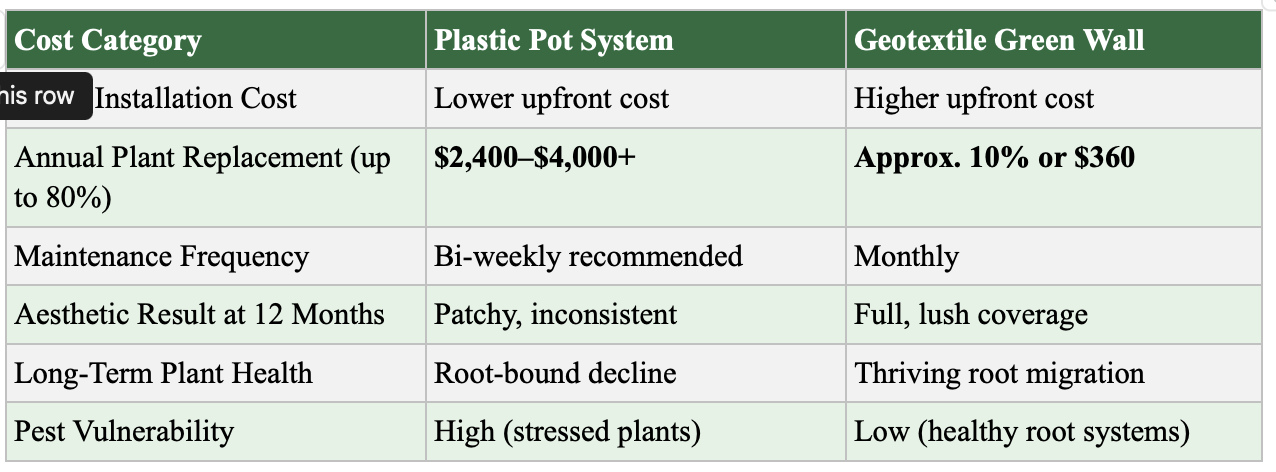
* Note: All living wall systems require ongoing maintenance, typically ranging from $2–$5/sf/month. Maintenance costs are assumed consistent across both systems and are not factored into this comparison. However, plastic pot systems may require additional bi-weekly visits, adding further cost.
After the first year, clients with an inferior plastic pot system will have nearly spent the "savings" they made upfront on unnecessary plant replacements, while still living with a wall that never achieved its intended lush, green tapestry.
Living Wall System Comparison at a Glance

The Bottom Line: Invest in Living Walls That Last
A living wall isn't just a visual statement, it's a long-term investment in a building's performance, design integrity, and the values of the people who inhabit it. A green wall, when supported by a proven, high-performance geotextile growing medium, becomes a durable architectural feature that thrives over time rather than degrading within its first year. The benefits of green walls are cleaner air, lower stress, a stronger design statement, only hold up if the system underneath is built to last, whether you're calling it a living wall, a green wall, or a vertical garden.
Whether you're specifying a green wall for a corporate lobby, a luxury residential tower, a healthcare environment, or an educational institution, the right system matters. By getting the infrastructure right from the start, you're not just enhancing the space, you're ensuring your client's investment is protected.
Ready to Integrate a Living Wall or Green Wall Into Your Next Project?
Lily Scott collaborates early with architects and construction teams to ensure every green wall is built cost-effectively, with a seamless and thriving aesthetic. Get in touch to start the conversation.